Heartland Pickleball logo: a red map of the Midwest states with a yellow pickleball over Indiana and Illinois Heartland Pickleball Midwest pickleball, covered like a beat
Breaking

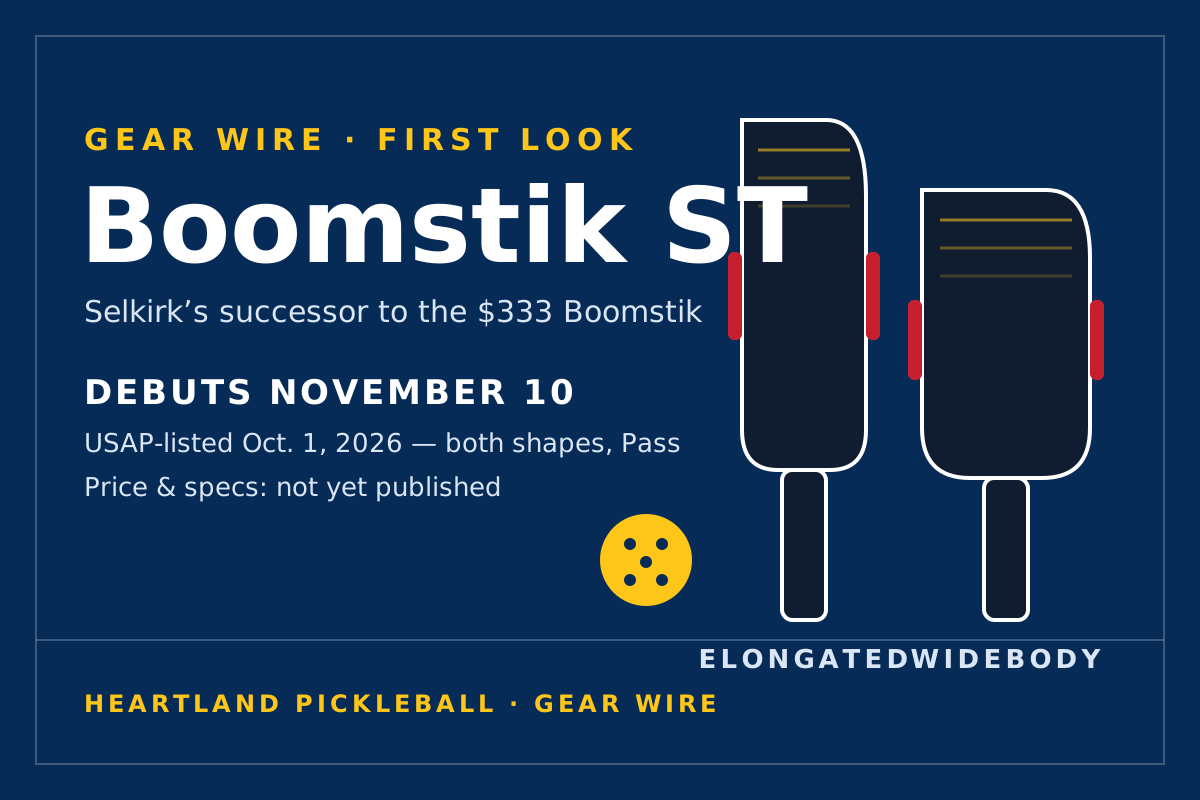
Selkirk's Boomstik ST goes on sale Nov. 10 — USAP-listed in two shapes, price still unpublished.

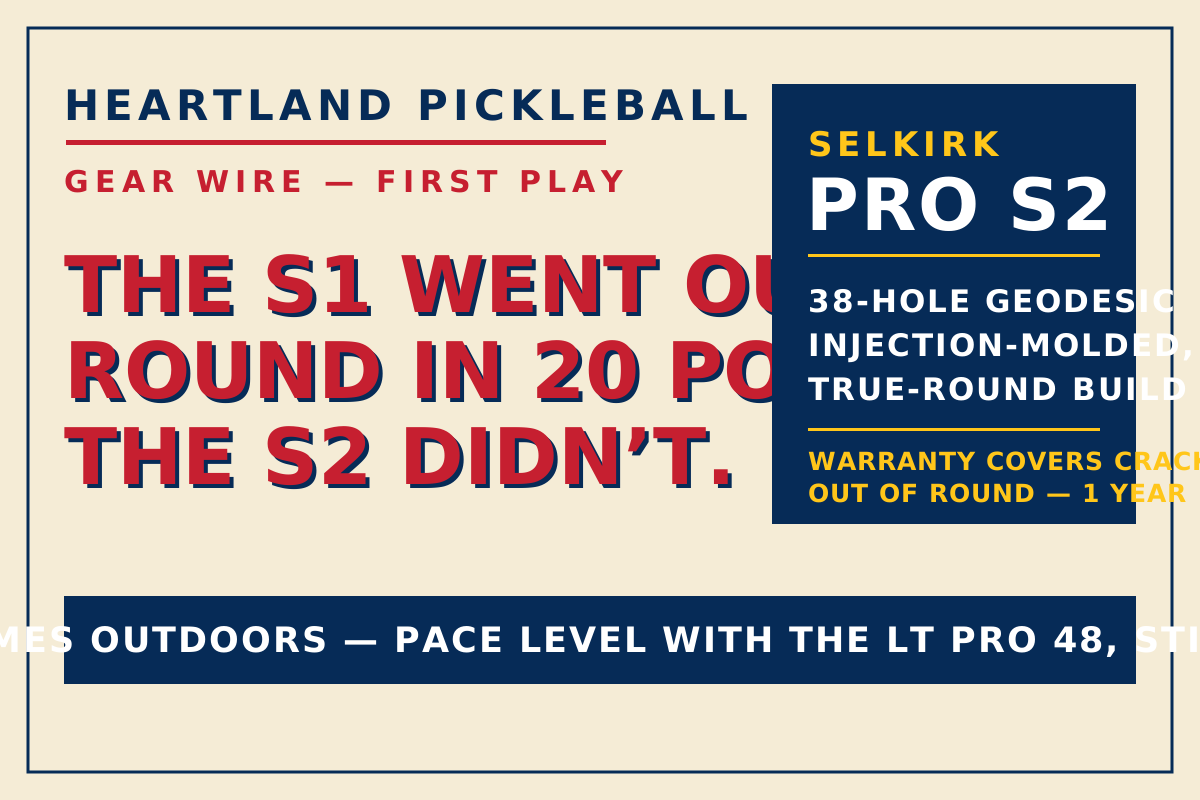
Heartland Gear Wire first-play card: Selkirk Pro S2 — played eight games outdoors, pace level with the LT Pro 48, still round, with a 1-year no-crack and out-of-round warranty
Heartland Gear Wire first play: eight games outdoors on the new Pro S2 — and it stayed round.
Gear Wire

Selkirk's Pro S2 Is Out — and It Answers the S1's Biggest Complaint

The S1 wouldn't crack, but it went out of round in 15–20 points. The S2 is Selkirk's direct answer — injection-molded true-round, with the warranty extended to cover going out of round. Our editor was one of the first at his club to play it.

Latest from the courts

Heartland Gear Wire first-play card: Selkirk Pro S2 — played eight games outdoors, pace level with the LT Pro 48, still round, with a 1-year no-crack and out-of-round warranty
Gear Wire

Selkirk's Pro S2 Is Out — and It Answers the S1's Biggest Complaint

The S1 wouldn't crack, but it went out of round in 15–20 points. The S2 is Selkirk's direct answer — injection-molded true-round, with the warranty extended to cover going out of round. Our editor was one of the first at his club to play it: eight games outdoors, and the early report on pace, roundness, spin, and visibility.

Nov 1, 2026 · Gear Wire
Heartland Gear Wire first-look card: Selkirk Boomstik ST, debuts November 10 — elongated and widebody paddle silhouettes with red MOI side weights; USAP-listed in both shapes, price and specs not yet published
Gear Wire

The Boomstik ST Is Coming Nov. 10: What Selkirk Has — and Hasn't — Said

Fourteen months after the $333 Boomstik reset the power market, its successor has a date, two shapes, and a USAP pass — and no published price or spec sheet. We separated what's confirmed from what's merely being said.

Nov 1, 2026 · Gear Wire
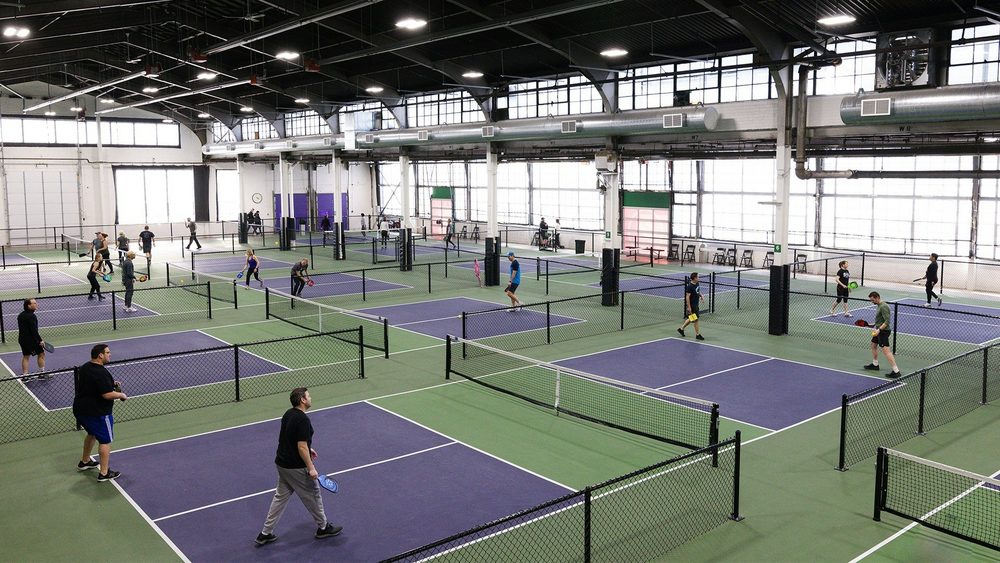
The courts inside Match Point Pickleball Club in Columbus, Ohio
Data Report

What a Membership Actually Costs in the Midwest

The region's big clubs all want a monthly commitment — only some will tell you in public what it costs. We checked the published numbers at 13 major clubs and chains so the math is in one place.

Oct 2026 · Data report
Inside The Pickle Lodge at Lunken Landing in Cincinnati, which opened in September 2026
Courts Coming

Courts Coming: Every Major Midwest Club Opening This Winter

What's already open, what's under construction, and what's still on paper across our ten states — plus the closings and cancellations, labeled exactly as the sources support them.

Oct 2026 · Courts Coming
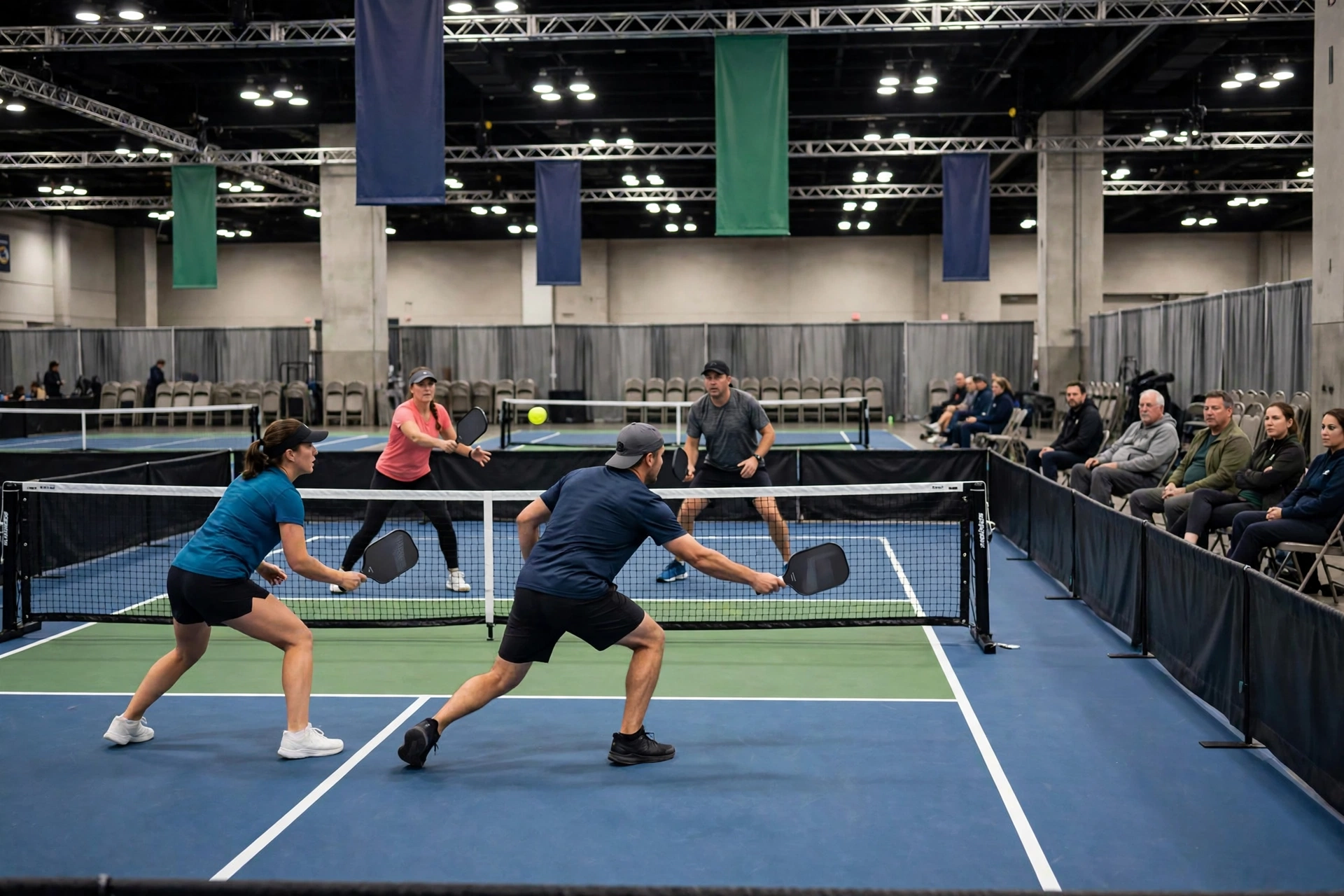
Players in the middle of a fast rally during tournament play
Feature

Is Momentum Real? Runs, Comebacks, and the 0–2 Hole

Every league night runs on it: one team can't miss, the other can't buy a point. Forty years of research, pickleball's own scoring math, and what a 0–2 hole actually costs.

Oct 2026 · Feature
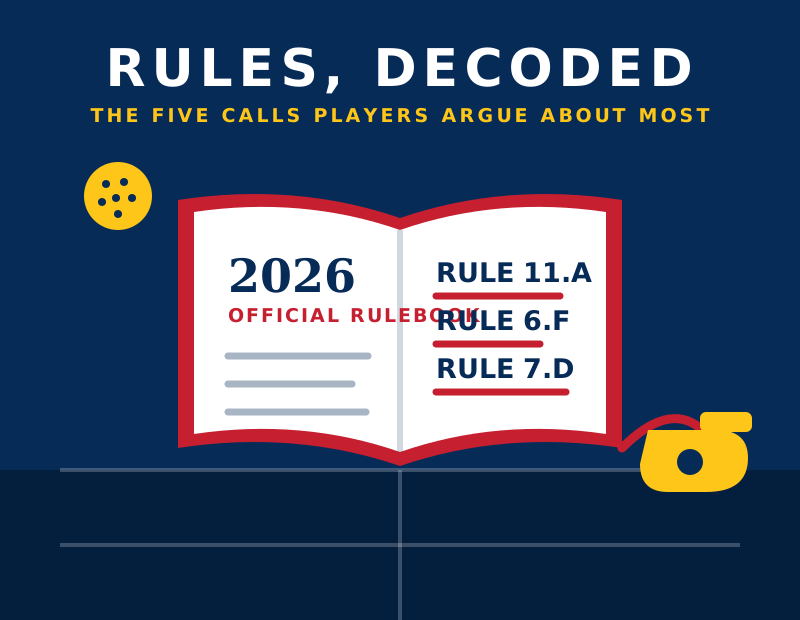
Rules, Decoded — flat illustration of the open 2026 USA Pickleball Official Rulebook with a referee whistle
Toolbox

Rules, Decoded: The Five Calls Players Argue About Most

The kitchen volley, the wrong score, the drop serve, the line call — every league-night argument has a written answer in the 2026 USA Pickleball rulebook. The rulings, the rule numbers, and what changed this year.

Oct 12, 2026 · 7 min read
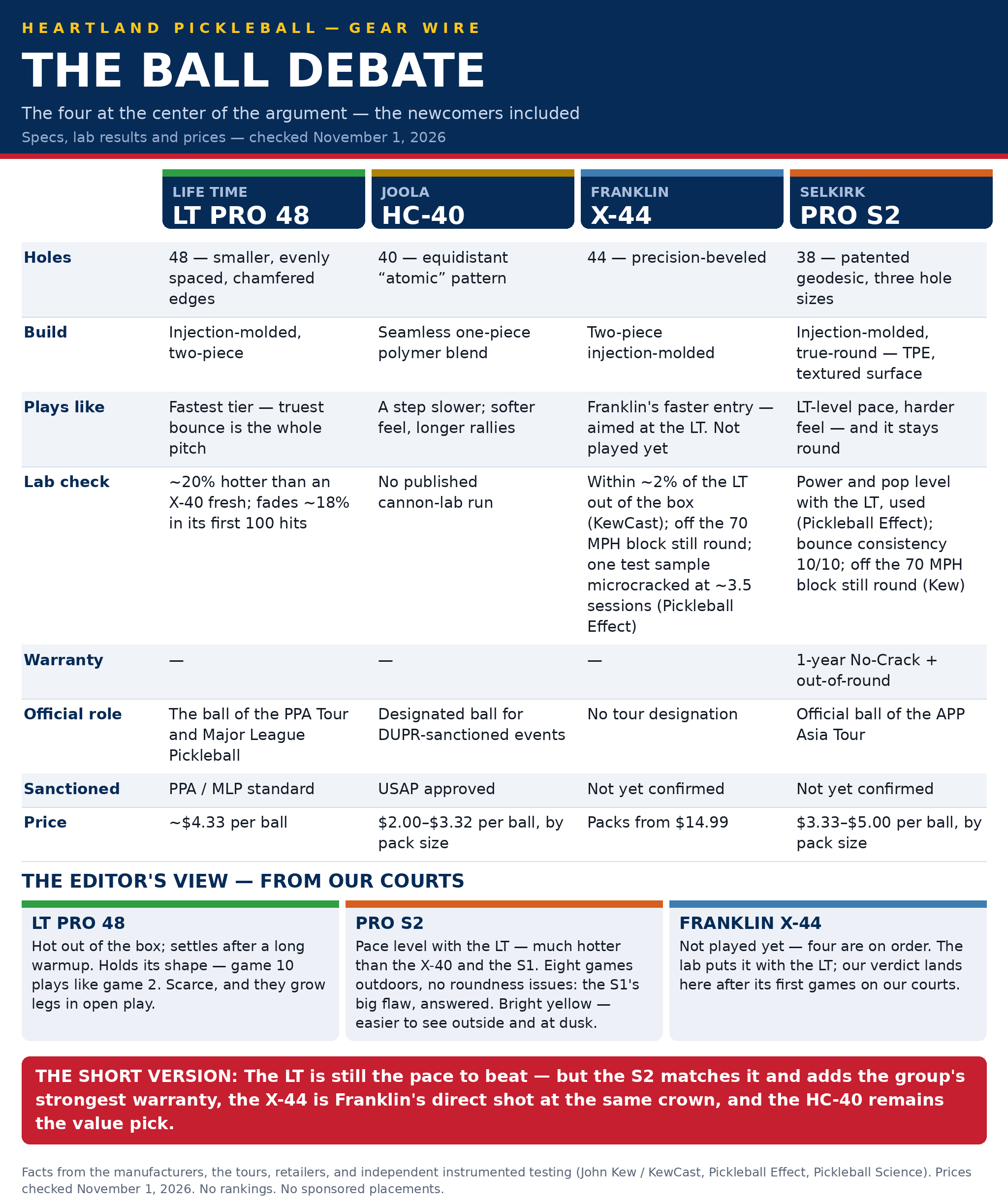
Heartland Gear Wire card: The Ball Debate — the LT Pro 48, JOOLA HC-40, Franklin X-44 and Selkirk Pro S2 compared on specs, lab results and prices
Gear Wire

The Ball Debate: Hot, Cracked, and Out of Round

Six balls are fighting for your club's basket — and the tours have already picked sides. Specs, independent lab results, checked prices and our own courts on the LT Pro 48, the HC-40, the X-44 and X-40, and Selkirk's Pro S1 and Pro S2.

Oct 11, 2026 · Updated Nov 1, 2026 · Gear Wire
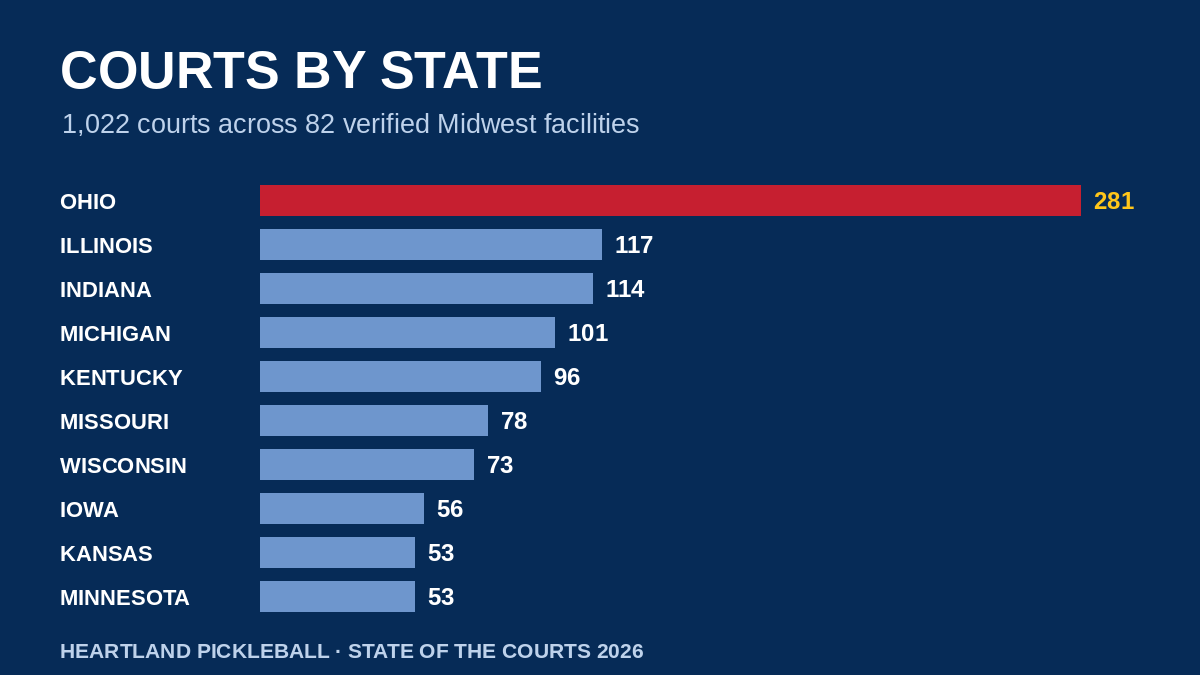
Bar chart: Courts by state — 1,022 courts across 82 verified Midwest facilities. Ohio leads with 281, followed by Illinois 117, Indiana 114, Michigan 101, Kentucky 96, Missouri 78, Wisconsin 73, Iowa 56, Kansas 53 and Minnesota 53.
Data Report

State of the Courts 2026: The Midwest, Counted

We counted every court in our verified directory: 1,022 courts at 82 facilities across 10 states. Ohio alone holds 281 — more than Indiana and Illinois combined — and 83% of facilities can host play in January.

Oct 2026 · Data report
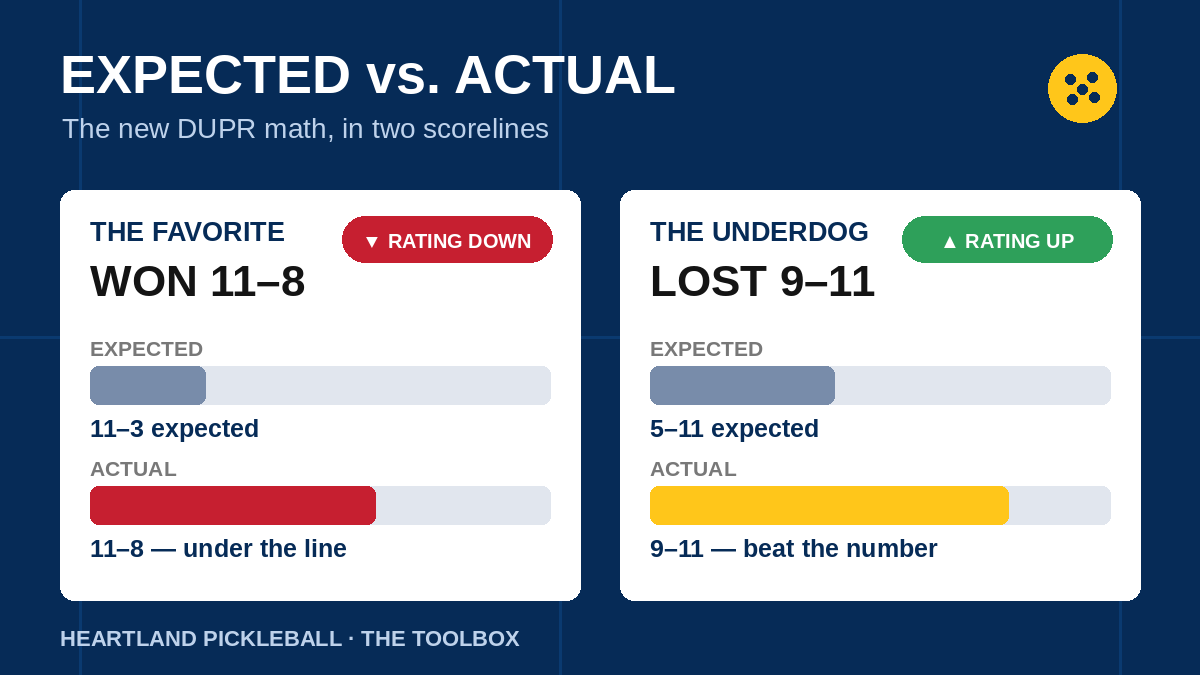
Infographic: Expected vs. Actual — the new DUPR math in two scorelines. The favorite won 11–8 but their rating went down; the underdog lost 9–11 but their rating went up.
Toolbox

You Won. Your Rating Dropped. Inside DUPR's New Math.

Since July 2025, DUPR grades every match against an expected score — win 11–8 when you were supposed to win 11–3 and your rating can fall. How the new algorithm works, and why the reviews are split.

Oct 10, 2026 · 8 min read
Players on court at The Dink House in Carmel, Indiana
Toolbox

The dink is the whole game. Here's how to own it.

Bangers win points. Dinkers win matches. The soft game — grip pressure, shoulder swing, patience at the kitchen line — broken down the way USA Pickleball teaches it.

Oct 9, 2026 · 5 min read
Players spread across the indoor courts at Lucky Shots Pickleball Club in Minneapolis
Season Preview

Indoor season is here: your winter play playbook

First frost ends the park-court era for the year. How the Heartland moves inside — league nights, ladder play, and the etiquette of the wait-list bench.

Oct 8, 2026 · 6 min read

Around the Heartland

Court directory →
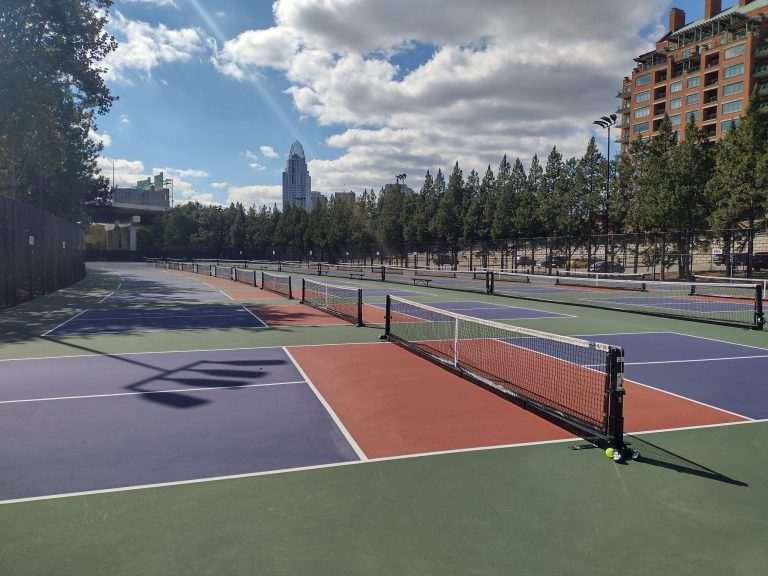
The courts at Sawyer Point in Cincinnati with the downtown skyline behind them
Sawyer Point · Cincinnati24 courts on the downtown riverfront
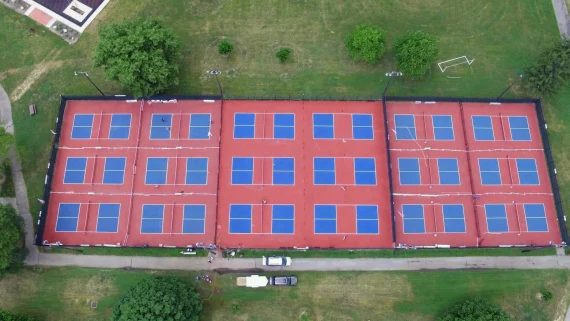
Aerial view of the red and blue courts at Lefferson Park in Middletown
Lefferson Park · Middletown27 courts of park-court open play
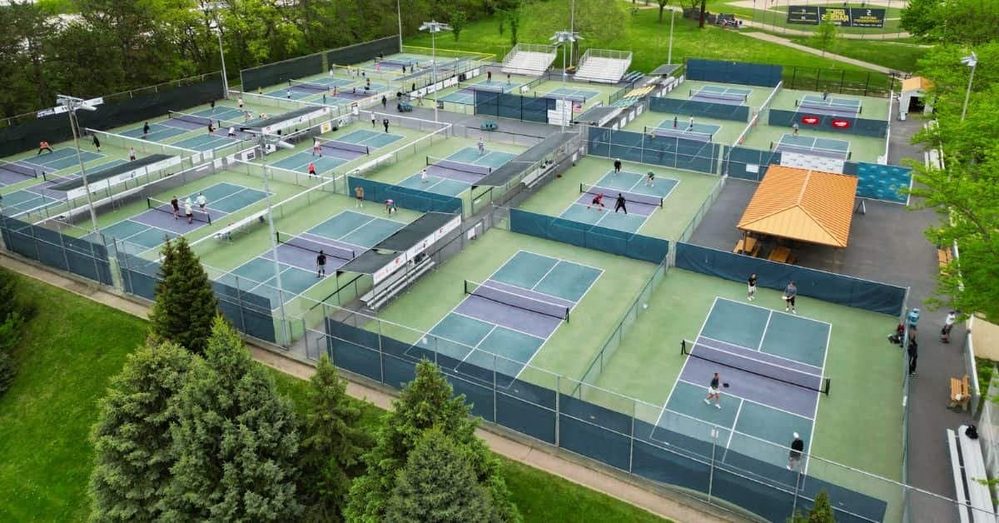
Aerial view of the courts at Belknap Park in Grand Rapids, Michigan, with players on them
Belknap Park · Grand Rapids21 courts of public play in Michigan

On the calendar

Full calendar →

The Kitchen Line — our weekly email

Every Monday morning: the weekend's results, registration deadlines before they sneak up on you, and one drill worth your Tuesday. Free, Midwest-only, no noise.

Gear Wire

Dropped, Fired, Filmed, Weighed: How Balls and Paddles Earn Their Numbers

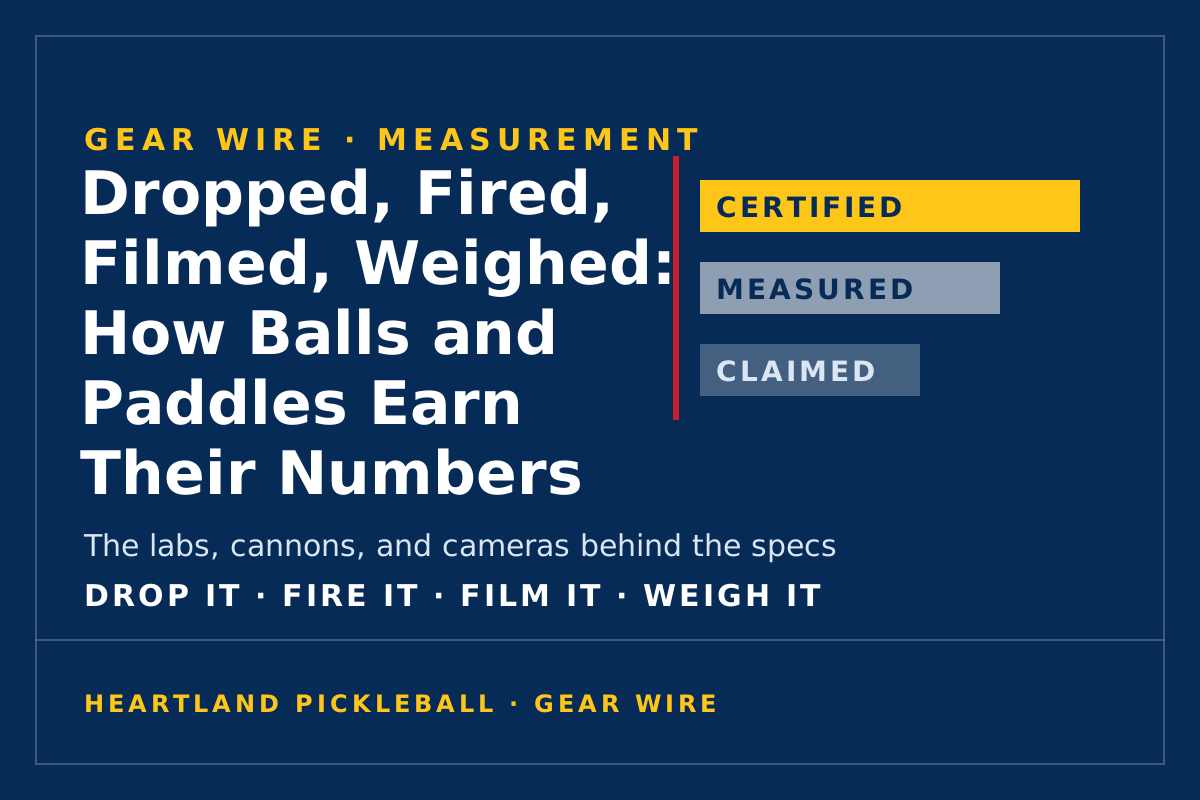
Heartland Gear Wire measurement card: Dropped, Fired, Filmed, Weighed: How Balls and Paddles Earn Their Numbers — the labs, cannons, and cameras behind the specs, sorted three ways: certified, measured, claimed. A Heartland graphic, not a product shot.

Every number attached to a ball or a paddle — the bounce on the sleeve, the weight on the listing, the word “approved” on the box — came out of a measurement somebody made, on some machine, under some protocol. Whose machine it was decides what the number is worth. This is a tour of the machines: the certification labs that gate the sport, the independent testers who publish their work, and the manufacturers whose numbers arrive with a marketing department attached. Ours is the smallest operation in the piece, and it comes last, where it belongs.

Above: every gear number is one of three things — certified, measured, or claimed. The card is a Heartland graphic, not a product shot.

A pickleball leaves the factory with exactly one honest thing about it: it can be measured. Everything else — how it plays in your league, how it feels in January, how long the grit lasts — is inference. The industry's answer to that problem is an apparatus of drop tests, air cannons, profilometers, radar guns, and high-speed cameras, run by three kinds of measurers with three different motives. A governing body wants a gate: numbers that keep the game the game. An independent tester wants a comparison: numbers that separate one product from another. A manufacturer wants a claim: a number that sells. The same figure can be any of the three, and it is worth a different amount in each case. Learning to tell them apart is most of what there is to know about gear.

1. The official gate

Start with the only numbers that can keep a product off a tournament court. USA Pickleball's Equipment Standards Manual is the sport's baseline specification, and for balls it reads like a metrology checklist. A legal ball measures 2.87 to 2.97 inches in diameter, with its diameter allowed to vary no more than ±0.020 inch around its own circumference — the out-of-round tolerance, written into the standard. It weighs between 0.78 and 0.935 ounces and carries 26 to 40 holes. Then come the two tests with real instruments behind them. In the bounce test, the ball is dropped from 78 inches onto a granite surface plate and must rebound 30 to 34 inches, measured to the top of the ball, at a room temperature of 70 degrees Fahrenheit, plus or minus five. In the compression test, run under the ASTM F1888-09 protocol, the ball is squeezed and must record an average compression result under 43 pounds of force, tested twice — once across the seam, once along it. A third reading, hardness on the Durometer D scale, is still taken and still published in the manual at 40 to 50 — but the manual now marks it “recorded for corollary data only.” It is measured, and it no longer decides anything. That distinction — between a number that gates and a number that is merely kept — runs through this entire piece.

Paddles face a longer gauntlet, and its newest test explains why the industry measures the way it now does. For years, paddle power was gated by a static deflection test — essentially a stiffness measurement, the paddle treated as a beam. USA Pickleball's own rulemaking document for its replacement is blunt about the problem: a static test “does not include any contributions for the way the forces are reacted” in a real collision, and a wave of designs had learned to be stiff on the bench and hot on the court. The replacement, in force since November 1, 2024, is the PBCoR test — Paddle-Ball Coefficient of Restitution. A ball is fired from an air cannon at a clamped paddle at about 60 mph; instruments record the inbound and outbound speeds, and the ratio, corrected for the paddle's mass properties, is the PBCoR. The protocol is adapted from the bat-testing standard used in baseball and softball, and it measures the thing itself — how much of the collision's energy the paddle hands back to the ball — rather than a property that merely correlates with it. The ceiling was set at 0.44 and tightened to 0.43 on November 1, 2025.

Spin got the same treatment a year later. The old proxy was surface texture: a Starrett SR160 roughness tester dragged across the face, with average roughness capped at 30 micrometers (Rz) and 40 micrometers (Rt), plus a kinetic friction ceiling of 0.1875. Proxies can be gamed, and different surfaces produce spin the stylus never sees, so for paddles submitted from October 1, 2026, USA Pickleball replaced the caps with a direct spin rate test — a dual-camera system, developed with the motion-analysis firm Image Systems, that watches a marked ball come off the face and counts its revolutions. The limit is 2,100 RPM. Roughness and friction are still measured; they are now, in USA Pickleball's phrase, “a measurement of record” — kept, like ball hardness, but no longer the gate.

The pro game runs a second gate alongside the first. Since September 1, 2025, professional play on the PPA Tour and in Major League Pickleball has required UPA-A certification, administered by an independent laboratory, Pickle Pro Labs, working with the Baseball Research Center at UMass Lowell. UPA-A's philosophy is stated in its own materials: output-based, not materials-based. Its power metric is the same physical quantity as PBCoR under another name — the Paddle Efficiency Factor, the ratio of exit to incoming ball velocity — capped lower: 0.385 for a new paddle. Its spin is measured directly, capped at the same 2,100 RPM. And it adds the test nobody else runs: an Accelerated Break-In, a controlled mechanical process that ages the paddle before it is measured again, after which its efficiency may rise no higher than 0.405 — and its spin may never exceed the cap at any point in its useful life.

What does passing all this certify? Something narrower than the box suggests. It certifies that samples the manufacturer submitted met the standard in force when they were tested. USA Pickleball's spin announcement says it plainly: certified paddles are held to “the equipment standards that were in effect at the time of certification,” which is why a paddle approved in September 2026 will never be spin-tested, and a paddle approved in 2024 was certified under a looser PBCoR ceiling than one approved today. Approval is also revocable — the last two years of delistings happened when re-testing of production paddles found drift the submitted samples hadn't shown. UPA-A writes the drift problem into its rules: production paddles must stay within ten percent of the certification measurements on all five of its key metrics, and certifications expire after 24 months. What approval does not certify, under either system, is anything a player would recognize as the product's character: how it plays, how it feels, or how long any of it lasts.

2. Balls under instruments

A ball is the simpler object, and the instruments for it are older and more physical. The granite drop test is the foundation — a rebound measurement so basic it is nearly a definition: drop height fixed, plate fixed, temperature fixed, and the rebound read to the top of the ball. Its tight little window, 30 to 34 inches, is what makes a tournament in Ohio play like a tournament in Arizona. The compression press answers a different question — not how high the ball bounces but how much force it takes to deform it — which is why the manual runs it twice, across and along the seam: a two-piece ball is not the same object in both directions, and the standard knows it.

Beyond the gate, measurement becomes comparison. Exit-speed testing puts a radar gun behind a hitter or a cannon and asks how fast the ball leaves — the pace number that separates a hot ball from a dead one. Durability rigs fire balls repeatedly and count what changes: bounce height before and after a break-in protocol, cracks logged against hits taken. Roundness, which the standard handles as a tolerance at certification, is in practice monitored by eye and by warranty claim — there is no league-night instrument for it, a gap that mattered when one prominent ball's shape failed in play long before any lab announced it.

And every ball number carries an asterisk the standard itself writes in: temperature. The bounce test is specified at 70 degrees, plus or minus five, because plastic's rebound is not a constant — it is a function of the room. A ball that measures mid-specification in a lab is a measurably harder, livelier, and more crack-prone object in January league play, and no figure printed on the sleeve says which ball you are getting. The standard controls the temperature because it has to; your season doesn't.

3. Paddles under instruments

The paddle is where the instrumentation gets serious, because the paddle is where the money and the arms race are. PBCoR deserves its plain-language moment, because it is the number currently deciding which paddles exist. Clamp the paddle so it can recoil the way it does in a hand, fire a ball at it at about 60 mph, and measure both speeds. If the ball arrives at 60 and the collision hands back a rebound ratio of 0.43, the paddle sits exactly at today's ceiling. The protocol also derives a ball exit speed ratio and folds in the paddle's balance point and moment of inertia — the collision depends on where the mass is, not just what the face is made of. That is the deep idea in modern paddle measurement: power is not a material, it is an event, and the instruments have stopped inspecting the material and started staging the event.

Deflection survives inside that world as the supporting measurement. The old static test bent the face under load and read the bend — a stiffness proxy, useful for catching a face that has gone soft or a production unit that has drifted. UPA-A still runs deflection as Average Deflection Force, and its officials carry a go/no-go version of the check to tournaments, comparing the paddle in a player's bag against the values it posted in the lab. It is the one certification instrument that ever leaves the laboratory.

The numbers players actually shop by come from a different bench: the pendulum machines. Swingweight and twist weight are both moments of inertia, measured by timing how a paddle oscillates — swingweight around an axis near the hand, twist weight around the paddle's long axis. The instrument the independent testers have standardized on is the Briffidi SW1, with adapters that set the axis where a grip would be. These two numbers explain the oldest puzzle in the paddle aisle: two paddles can weigh the same 8.0 ounces on a kitchen scale and be different objects entirely, because the scale cannot tell you where the ounces live. Swingweight is how heavy the paddle feels mid-swing; twist weight is how hard it fights you on an off-center hit. Neither is gated by anyone. They are pure comparison numbers — which is exactly why the testers, not the rulebook, own them.

Surface measurement is the third bench. A profilometer — USA Pickleball's protocol names the Starrett SR160 — drags a stylus across the face and records the terrain in micrometers, peak to valley. An abrasion machine then wears the face down and the stylus goes back, because a grit number is a photograph, not a movie: faces that start rough do not all stay rough. And spin, the property the stylus was always standing in for, is now counted directly by the cameras, in the certification lab and on the testers' courts alike.

4. The independent testers

Between the gates and the claims sits a small industry of people who bought the machines themselves. Their methods are published, which is what separates a tester from an influencer: you can argue with a protocol, but first you have to be able to read it.

Pickleball Effect — Braydon Unsicker, a 5.0 player who has measured more than 500 paddles — runs the most completely documented operation. Swingweight and twist weight come off the Briffidi SW1, balance off a dedicated device, roughness off the same Starrett SR160 the rulebook names. Power, pop, and spin come off a Stalker radar unit on an indoor court, as averages of ten swings each — ten serves for power, ten punch volleys for pop, ten serves for spin — all hit by the same tester, with the same ball, at a controlled temperature. The human arm is the least repeatable instrument in the building, and the method controls for it the only way available: never change the arm. His grit numbers come off an in-house abrasion machine, before and after wear. When Pickleball Effect turned the same kit on balls last month, the results showed what comparison measurement is for: the Selkirk Pro S2 and the Life Time LT Pro 48 tied on power at 59.70 mph, and after a break-in protocol the S2's bounce had fallen 0.06 inches against 0.37 for the LT and 1.15 for the Franklin X-44 — a durability gradient no amount of ordinary play could isolate that cleanly.

John Kew's lab is the cannon shop. His ball work fires 500 hits at 50 mph and watches what survives — the LT Pro 48 came out of that rig the fastest ball tested and uncracked; the X-40 never cracked either, it just slowed down. His laboratory COR measurements put the X-44 and the LT within about two percent of each other and both roughly a fifth more powerful than the X-40. For paddles he runs the same Briffidi pendulum measurements as Pickleball Effect — one reason the two databases can be read side by side — plus his own COR figure, cannon spin testing under high-speed cameras, and X-rays that show what is actually inside the core. Pickleball Science, the third name in the file, works the materials end: stiffness testing that caught the X-40 softening faster than the Onix Dura Fast 40 while lasting about as long before cracking, roughly 30 games.

Where independent numbers earn their keep is corroboration and contradiction. When two labs with different rigs agree — the LT is fast and stays fast, the X-40 is slow and durable — a player can treat the point as settled in a way no single source allows. When a measured number contradicts a published one, the measurement is the news. And the testers are honest about their noise floors, which is how you can tell the work is real. Spin is the standing case study: across four front-line balls on Pickleball Effect's rig, spin came out between 2,089 and 2,126 RPM — a spread the tester himself says he wouldn't choose among the balls on. Thirty-seven RPM is not a difference; it is the sound of the instrument breathing. Any ranking built on it is fiction, whoever publishes it.

5. What no instrument measures

For everything the machines settle, there is a remainder they don't touch. No rig runs for six months. Abrasion machines approximate grit wear and cannon protocols approximate durability, but the actual life of a ball or a face is lived across a season of garages, trunks, and Tuesdays, and the only instrument that integrates all of that is play itself. No certification measures the paddle you actually bought — the labs measured submitted samples, and UPA-A's rule that production units stay within ten percent of them is the industry conceding, in writing, that unit-to-unit spread is real. The box of twelve balls on your shelf is a population, not a specification. And the instruments are silent on the properties players talk about most: feel, sound, the sense of a ball sitting on the face. Those are not failures of measurement. They are the boundary of it.

Which is where played-here reports belong — ours included, and briefly, because they are the smallest instrument in this article and they know it. Heartland's gear coverage rests on a simple standard: balls and paddles logged in real games, roundness and cracks checked as they happen, prices checked and dated, and nothing called a finding until we have played it. Play is a terrible laboratory — one observer, no controls, weather included. It is also the only test that runs the product the way the product is used. The lab number tells you what a ball is. A season of Tuesday nights tells you what it becomes.

So read every gear number the way the people who produced it would have to defend it. Ask whose instrument made it: a gate, a comparison, or a claim. Ask what it was measured on: a submitted sample, a production unit, or a ball out of the same box you buy. Ask which standard was in force, and when — because a 2024 approval and a 2026 approval are different promises wearing the same word. And ask what the number cannot see. The sport's measurement apparatus has gotten genuinely good in three years; the cannons and cameras are real, and the people running them publish their work. The numbers are worth trusting exactly as far as the protocol behind them — and no further. That was always the deal. Now you know the terms.

The Measurement Map — who measures what

Four kinds of measurers, two products, and the instruments behind the numbers. Read any gear figure against its row.

MeasurerBallsPaddles
USA Pickleball — the certification gateBounce 30–34 in from a 78-in drop onto granite at 70°F ±5; compression under 43 lbf (ASTM F1888-09); diameter 2.87–2.97 in, out-of-round within ±0.020 in; weight 0.78–0.935 oz; hardness recorded, no longer gated.PBCoR power test — air cannon at ~60 mph, ceiling 0.43; spin rate test — dual-camera, ceiling 2,100 RPM for paddles submitted from October 1, 2026; roughness and friction now a “measurement of record.”
UPA-A / Pickle Pro Labs — the pro game's second gateDoes not certify them; uses a standard ball in its paddle cannon tests.PEF power ratio ≤0.385 new, ≤0.405 after accelerated break-in; spin measured directly, ≤2,100 RPM for the paddle's life; deflection (ADF), moment of inertia, roughness; production units within 10% of certified values; certifications expire at 24 months.
Independent testers — Pickleball Effect · John Kew · Pickleball ScienceRadar exit speeds; bounce before and after break-in; cannon durability (500 hits at 50 mph); laboratory COR; stiffness over time.Swingweight and twist weight (Briffidi SW1); radar power, pop, and spin as ten-swing averages; abrasion-machine grit wear; X-ray teardowns.
Manufacturers — claims, and the samples everyone else measuresPublish size and weight; durability claims from in-house rigs (Selkirk's 3,000-shot, 110 MPH cannon figure for the Pro S2 is a maker's claim, printed here as one).Publish weight, dimensions, and core specs; submit the samples the gates above are run on.

The gates decide what may be sold as legal. The testers decide what can be compared. The makers decide what gets claimed. Play decides the rest.

Sources

  • USA Pickleball — Equipment Standards Manual (Rev. 3.0, Jan 2025) and the equipment testing program: equipment.usapickleball.org
  • USA Pickleball — NPRM 24-002, the PBCoR rulemaking and test protocol (Oct. 1, 2024): the PBCoR testing document (PDF)
  • USA Pickleball — “USA Pickleball Activates Spin Rate Test,” news release, July 8, 2026 (revised Sept. 16, 2026): the 2,100 RPM limit, the dual-camera system, and the standards-in-effect-at-certification rule.
  • UPA-A — Paddle Specifications & Testing Requirements v26.6 (July 28, 2026) and program overview: upaa.unitedpickleball.com
  • Pickleball Effect — published testing methodology (Briffidi SW1, Stalker radar, Starrett SR160, abrasion machine) and its ball test of Oct. 28, 2026: how Pickleball Effect tests; the ball numbers also appear in The Ball Debate's “What the instruments say” box
  • John Kew — testing glossary (Briffidi SW1 swingweight and twist weight, KewCOR) and ball cannon testing: johnkewpickleball.com/glossary
  • Pickleball Science — stiffness testing, as summarized by Pickleball Union and cited in The Ball Debate.

All specifications above were checked against these sources on November 3, 2026. Standards change — USA Pickleball's spin test is the third major measurement change in three seasons — and approval is always as of the governing body's current list.

Sources: USA Pickleball Equipment Standards Manual (Rev. 3.0, Jan 2025); USA Pickleball NPRM 24-002 — PBCoR testing (Oct. 1, 2024); USA Pickleball, “USA Pickleball Activates Spin Rate Test” (Jul. 8, 2026, rev. Sep. 16, 2026); UPA-A Paddle Specifications & Testing Requirements v26.6 (Jul. 28, 2026) and upaa.unitedpickleball.com; Pickleball Effect — published testing methodology and ball test (Oct. 28, 2026); John Kew — testing glossary and cannon testing; Pickleball Science stiffness testing (as summarized by Pickleball Union). All checked November 3, 2026. Heartland received no products or payment for this coverage.
Find a game

The Heartland court directory — clubs, indoor facilities, and park courts where a visiting player can actually get a game. Every facility has its own page: open any card to get its address, directions, source, and what's coming up there. Filter by state, and always check the club's own schedule before you drive: open-play hours move with league seasons.

82 facilities across 10 states — every entry sourced, with its street address, court counts exactly as listed by its source, and a real photo of the facility wherever one could be verified. “Not stated” means the source didn’t publish a count — we don’t guess.

This directory is the dataset behind our annual count of the region — 1,022 courts in all. And for what is opening, closing, and still on paper this winter:

Payment never changes the order
Programs

Every facility plotted from its published street address. Tap a pin for the address, court count, and directions — the pins follow the state and indoor/outdoor filters and the search above.

Run a facility?

Claim your free page. Facility Pro adds your schedules, offers, and booking links — here and on your page.

The league-night rhythm

Every Heartland club runs on the same weekly heartbeat. Learn the rhythm once and you can drop into a game in any town in the region.

Weekly
Tue
Evening

Skill-bracket league night

The competitive staple — 4.0+ coed ladders and league blocks, DUPR-reported at most clubs. Arrive early; brackets lock at start time.
DUPR rated
Weekly
Wed
Evening

Beer league & social ladders

Rotating partners, looser stakes, a cooler by the bench. The best on-ramp in the sport if you're new in town — skill matters less than showing up twice.
All levels
Weekly
Thu
Evening

Team league night

Fixed squads, season standings, MLP-style team scoring at some clubs. Commitment is the point — your team notices when you're gone.
Season play
Daily
6 AM
Early

Sunrise open play

Paddle-stack rotation at park courts and clubs alike. Winners stay, split after two — and the coffee afterward is half the tradition.
Drop-in

Winter tournament calendar

The drive-worthy weekends across the Heartland from mid-November through the end of the year — nine events in all: two APP Moneyball stops with guaranteed prize money, the APA's Cincinnati Open in Mason and its Amateur Open Nationals in Columbus, a fifth-annual regional in Noblesville, two Pickle Lodge weekends in West Chester including the ThanksPickle parent/child tournament and the year-end WinterMAX, and winter round robins indoors. Details verified against organizer listings on November 1, 2026; entry fees and deadlines change, so confirm on the official listing before you book a hotel.

Before you register

Know your number

Most Heartland events bracket by DUPR rating — divisions sorted by skill first, then age. If you don't have a rating yet, play one rated league night or round robin before you enter, so you're bracketed on evidence instead of a guess. The Toolbox has the full explainer.

Read the fine print

  • Games guaranteed — a 6-game guarantee beats a single-elimination bracket at the same price.
  • Partner locked? — some events let you register solo and match you; most regionals expect you to bring your partner.
  • Ball & surface — the same ball plays on hardcourt surfaces indoors and out; what changes the game is the floor. Events on gym floors play slower than hardcourt. Adjust expectations, and your third shot.
  • Refund policy — weather and withdrawal rules vary by organizer. Screenshot them at registration.

The player's toolbox

The reference shelf: ratings, scoring, the shots that matter, and the unwritten rules that make you welcome back at any court in the region.

Which division should you enter?

Pick the level that honestly sounds like you. We'll translate it into the bracket language tournament directors actually use.

What's my DUPR? — the estimator

The division guide above assumes you know your rating. If you don't have a DUPR yet, answer ten honest questions about your game — strokes, consistency, and, most of all, your results against players who do have ratings — and we'll estimate the range you're probably playing in.

How it works: one question at a time, four answers each, about two minutes. Be honest rather than flattering — the estimate is only useful if it's true, and the last question (your results against rated players) counts double, because results calibrate better than self-described strokes.

Anatomy of a court

A pickleball court is 20 × 44 feet — badminton-sized — split by a net that stands 36 inches at the posts and 34 in the middle. Tap a zone to see what it decides.

SERVICE BOX THE KITCHEN · 7 FT SERVICE BOX BASELINE

Rules, decoded

The five calls that end league-night rallies in an argument — each one settled by the 2026 USA Pickleball Official Rulebook, with the rule number attached:

  • The kitchen volley & momentum — Rule 11.A: the volley isn't over until your momentum is, even after the ball is dead.
  • Re-establishing your feet — Rule 11.A.3: both feet completely out of the zone before you volley again. One foot out isn't out.
  • Challenging the score — Rule 6.F: there's a window, it's short, and stopping play on a correct score is a fault on you.
  • The drop serve — Rule 7.D: the volley serve's geometry tests don't apply once the ball bounces; the release rules do.
  • Line calls — Section 8: an “out” shouted mid-flight is partner talk, not a call — and partners who disagree lose. The ball is in.

DUPR, decoded

DUPR is the rating most Heartland tournaments and rated leagues report to. The plain-English version:

  • One number, 2.000–8.000 — separate ratings for doubles and singles.
  • Every reported game counts — who you played, who your partner was, and the score all feed the math. Beating a stronger team moves you more than beating a weaker one.
  • Reliability matters — a young rating swings fast. It settles as your match count grows, so early jumps up and down are normal.
  • Brackets trust it — directors sort divisions by rating first, then age, which is why one rated night before your first tournament is worth it.

Scoring, without the argument

Traditional side-out scoring: only the serving team can score, and in doubles both partners serve before the ball changes hands — except the very first turn of the game. The call is three numbers:

4 – 2 – 1
  • 4 — your team's score
  • 2 — their score
  • 1 — server number: first or second server on your team

Games usually run to 11, win by 2. Some leagues and pro team formats use rally scoring (every rally scores, games to 21) — ask at check-in which one you're playing before the first serve, not after the first dispute.

The dink, in five moves

The soft shot that lands in the kitchen and can't be attacked. It's the most important shot in the sport, and "less is more" is the whole secret:

  • Continental grip, held loose — about a 2 out of 10 on grip pressure.
  • Live at the kitchen line, knees bent, paddle up and in front of you.
  • Swing from the shoulder — a gentle push, no wrist snap, no backswing.
  • Lift, don't hit — paddle face open, ball arcs and drops just over the net.
  • Aim at feet and backhands, or crosscourt to pull them wide — then be patient. Dink until they miss.

Open-play etiquette

  • Stack your paddle — the paddle line is the rotation. Yours goes at the back of the stack, no exceptions for "just one more."
  • Call the score out loud before every serve, all three numbers.
  • Line calls favor the shooter — if you're not sure it's out, it's in. Replay the point if the court can't agree.
  • Winners stay, split after two — standard rotation at busy courts keeps the wait honest.
  • Warn the next court — "ball on!" the second yours rolls over. Every time.
  • Tap paddles, mean it — the post-game tap is the sport's handshake. Bad games included.
Flat designed graphic in Heartland navy, red and yellow: a kit bag, two paddles and pickleballs — Pack, Play, Repeat

The bag checklist

What seasoned Heartland players actually carry — tuned for a region where a October morning can start at 45° and finish at 75°.

  • Two paddles — your gamer and a backup. Edges chip; tournaments don't wait.
  • Balls — three spares — the same hardcourt ball you play outdoors is what's in play on indoor hardcourts. The one surface that changes the game is a gym floor; if your winter spot is a gym, ask what ball the house runs there.
  • Court shoes, not running shoes — lateral support is the whole point.
  • Layers — a quarter-zip for the first rotation that comes off by game three.
  • Overgrip + electrical tape — a five-minute fix for a worn grip or a nicked edge guard.
  • Water and something salty — two-hour league nights drain more than you think.
  • A small notebook — scores, partner notes, who owes whom a rematch.

Gear Wire

The decision desk

Played here. Checked again.

Heartland tracks gear through real Midwest play and scheduled follow-ups — no rankings, no sponsored placements, no verdict on anything we haven’t played.

Start with your level

Pick a level and Gear Wire surfaces the files and stories that speak to your game — dimming the rest, not deleting them. Level notes use only judgments the Ball Debate and the Editor’s View have already published; where no level-specific content exists, the general file applies.

Gear files

One living file per covered product: the evidence badge says how we know, the price carries its check date, and the finding is the latest word from published Heartland coverage. No star ratings, no rankings, no “best” labels.

Played here
Ball

Selkirk Pro S2

$14.99 3-pack · selkirk.com
12-pack$39.99
CheckedNov 1, 2026

Both packs were sold out at selkirk.com when checked Nov. 1.

Buy at Selkirk — $14.99 / 3-pack · $39.99 / 12-pack at selkirk.com — both sold out at our November 1 check; this page is where restocks land.

Latest finding: the editor has played eight outdoor games on it — no roundness issues, where the S1 went out of round in 15–20 points — and the pace sits near the LT Pro 48.

Played here
Ball

Life Time LT Pro 48

~$4.33 per ball · LT Shop / Pickleball Central
CheckedOct 11, 2026
Official rolePPA Tour + MLP ball

Buy the LT Pro 48 at Pickleball Central — In stock at Pickleball Central at our November 1, 2026 check.

Latest finding: hot out of the box, then settles — and it holds its shape. The catch is supply: scarce outside Life Time channels.

Checked not played
Ball

Franklin X-44

From $14.99 franklinsports.com
CheckedNov 1, 2026
Build44 beveled holes · two-piece injection-molded

Buy the X-44 at Franklin — From $14.99 at franklinsports.com — checked November 1, 2026; excluded from Franklin coupons and promotions.

Status: now available at franklinsports.com. The editor has a set on order — first play will be added to this file when it happens. No date promised, and no verdict until it’s played.

Checked not played
Ball

JOOLA HC-40

$9.95 3-pack · joola.com
CheckedOct 11, 2026
12-pack / 40-pack$29.95 / $99.95

Buy the HC-40 at JOOLA — $9.95 / 3-pack at joola.com — in stock at our November 1, 2026 check.

Status: the designated ball for DUPR-sanctioned events since September 1, 2026. Recorded ≠ sanctioned — a DUPR-recorded league night is not automatically a DUPR-sanctioned event, so check the event’s own ball rule. We have checked this ball; we have not played it, so there is no verdict here.

Played here
Ball

Franklin X-40

$1.80–$2.92 per ball · Dick’s / Pickleball Central
CheckedOct 11, 2026
Official roleUS Open + APP Tour ball

Buy the X-40 at Midwest Racquet Sports — $29.99 / 12-pack · $16.75 / 6-pack at Midwest Racquet Sports — checked November 1, 2026.

Latest finding: the slower, more forgiving ball in the group — and crack-prone over time. Its case was never performance: it’s price, availability, and that everybody already knows how it plays.

Played here
Paddle

Selkirk LABS Project Boomstik

$333 selkirk.com
CheckedNov 1, 2026
StatusThe editor’s current paddle

Buy the Boomstik at Selkirk — $333 at selkirk.com — sold out at our November 1, 2026 check; this page is where Selkirk sells the LABS line.

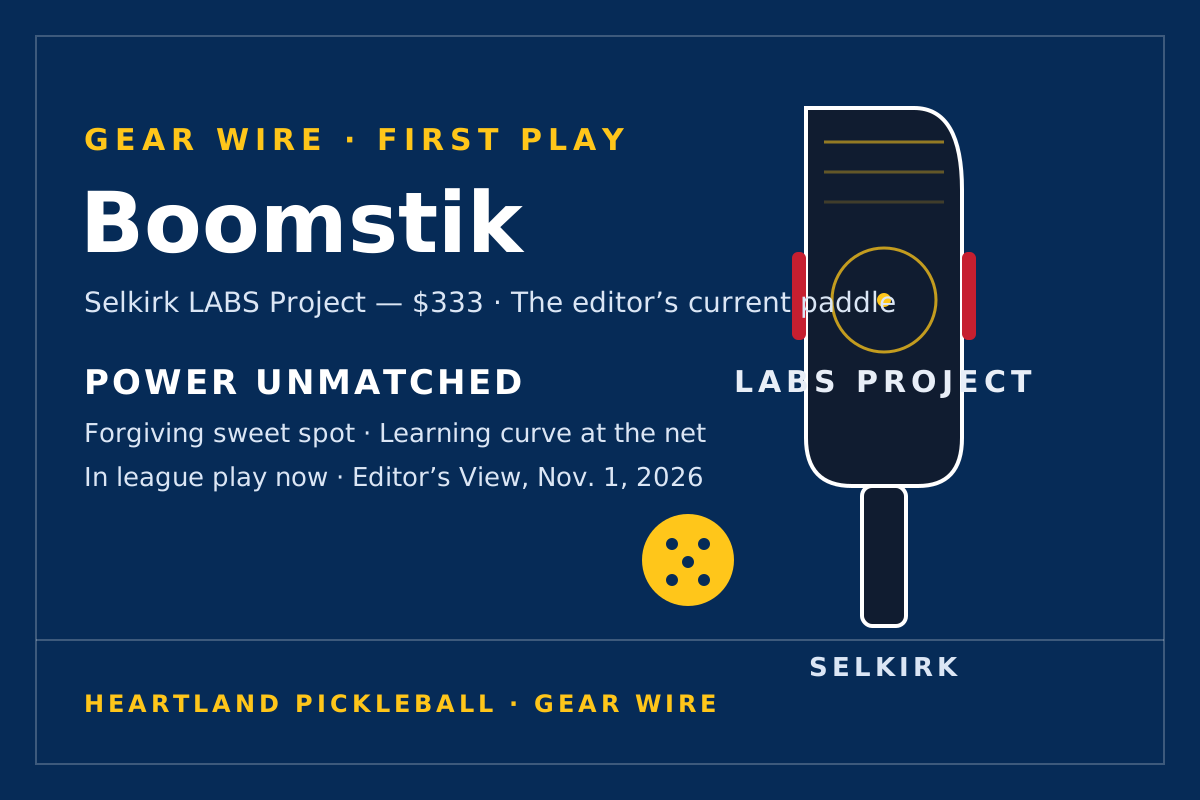
Latest finding: power unmatched, a sweet spot far more forgiving than the previous Selkirk, JOOLA, and CRBN TruFoam paddles the editor has played, and a learning curve to harness that power and get comfortable at the net. The editor’s current paddle, in league play now — the full first play is linked below. Its successor, the Boomstik ST, launches November 10.

Played here
Paddle

JOOLA Perseus Power FX 16mm

$179.95 joola.com
CheckedNov 1, 2026
ShapeElongated Perseus · 16.5″ × 7.5″ · 8.0 oz avg.

Buy the Power FX at Midwest Racquet Sports — $179.95 at Midwest Racquet Sports — checked November 1, 2026.

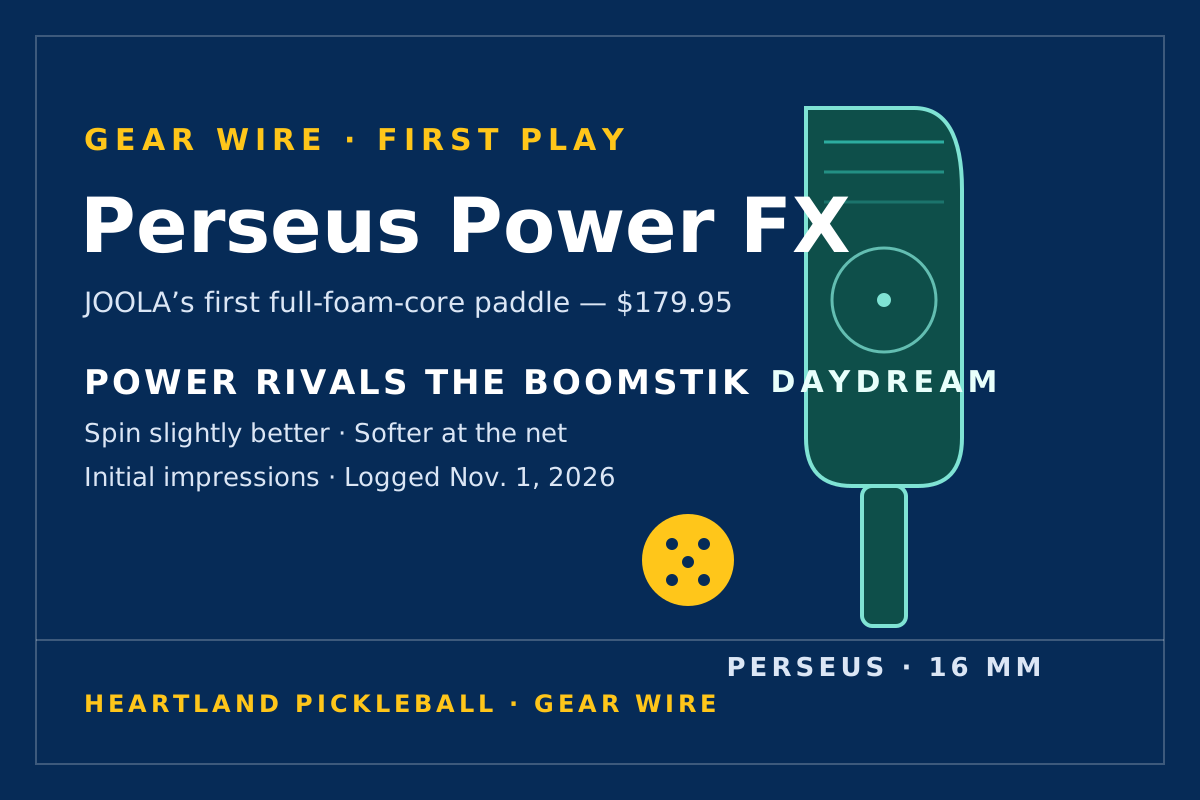
Latest finding: first-play power rivals the Boomstik, spin is slightly better, and it plays a little softer — so control at the net is slightly better too. Initial impressions, logged Nov. 1, 2026; a continued-play recheck is on the board.

Watching
Paddle

Selkirk Boomstik ST

Not yet published price
LaunchesNov 10, 2026
USAP listPass · Elongated & Widebody, listed Oct 1, 2026

Status: price, specs, and core have not been published by Selkirk yet. Successor to the $333 LABS Project Boomstik — we’re watching for the launch, not reviewing a press release.

The recheck board — what we’re checking next

Scheduled checks, shown as upcoming. Nothing here is a result — when a check happens, the file above is what changes.

  • Boomstik ST launch — Nov 10, 2026: price and specs, when Selkirk publishes them.
  • Perseus Power FX — continued-play recheck: whether the first-play impressions hold with more play — power and spin against the Boomstik baseline, and the softer feel at the net. The finding lands in the Power FX file and its first-play story when the recheck happens.
  • X-44 first play: when the editor’s set arrives — first play added to the X-44 file and the Ball Debate, with no verdict before then.
  • S2 durability recheck — 30-day: whether the roundness holds past the first eight games, and whether cracking shows up.
  • Ball Debate price recheck: pack prices across the ball comparison, re-checked against the same sources.

Articles by question

What fits my level?

Heartland Gear Wire card: The Ball Debate — the LT Pro 48, JOOLA HC-40, Franklin X-44 and Selkirk Pro S2 compared on specs, lab results and prices

The Ball Debate: Hot, Cracked, and Out of Round

Six balls lined up on specs, the one independent lab in the debate, and the Editor’s View — the slower, forgiving X-40 against the hotter S2 and LT Pro 48. Start here if the question is which ball suits the game you play.

What did we actually play?

Heartland Gear Wire first-play card: Selkirk Pro S2 — played eight games outdoors, pace level with the LT Pro 48, still round, with a 1-year no-crack and out-of-round warranty

Selkirk’s Pro S2 Is Out — and It Answers the S1’s Biggest Complaint

The first play: eight outdoor games. Pace very similar to the LT Pro 48, no roundness issues at all — and an honest note on what eight games can’t grade yet, like cracking.

Heartland Gear Wire first-play card: JOOLA Perseus Power FX 16mm — JOOLA's first full-foam-core paddle in the Daydream green-teal colorway; first play: power rivals the Boomstik, spin slightly better, softer feel at the net

JOOLA Perseus Power FX 16mm: First Play — Power That Rivals the Boomstik

JOOLA’s first full-foam-core paddle at $179.95, measured against the $333 Boomstik the editor plays now: power that rivals it, slightly better spin, and a slightly softer feel that helps at the net. Initial impressions, logged Nov. 1 — a continued-play recheck is on the board.

Heartland Gear Wire first-play card: Selkirk LABS Project Boomstik — the editor's current paddle at $333; first play: power unmatched, a far more forgiving sweet spot, and a learning curve to harness the power at the net

Selkirk LABS Project Boomstik: First Play — Power Is Unmatched

The $333 LABS Project paddle the editor plays now, in league play: power that is unmatched, a sweet spot far more forgiving than the previous Selkirk, JOOLA, and CRBN TruFoam paddles he has played — and a learning curve to harness that pop at the net. Editor’s View logged Nov. 1.

What changed?

Heartland Gear Wire first-look card: Selkirk Boomstik ST, debuts November 10 — elongated and widebody paddle silhouettes; USAP-listed in both shapes, price and specs not yet published

The Boomstik ST Is Coming Nov. 10: What Selkirk Has — and Hasn’t — Said

The $333 LABS Boomstik gets a successor. What’s confirmed is short and checkable — both shapes already sit on the USAP approved list — and everything else is labeled as what it is: not yet published.

What’s legal this weekend?

Approval & Availability Wire

“Approved” is no longer one universal label. The Facolos removal, the two paddles under investigation, and the current price wire — match your exact model and variant to your event’s standard before you enter.

How do we know?

Heartland Gear Wire measurement card: Dropped, Fired, Filmed, Weighed: How Balls and Paddles Earn Their Numbers — the labs, cannons, and cameras behind the specs, sorted as certified, measured, or claimed

Dropped, Fired, Filmed, Weighed: How Balls and Paddles Earn Their Numbers

Who measures balls and paddles, with what machines, and what the numbers certify: the USA Pickleball and UPA-A gates, the independent testers’ rigs, the manufacturers’ claims — and where played-here reports fit.

Read how they’re measured →

Approval & availability wire

Approval Watch

Approval is now part of the purchase

“Approved” is no longer one universal label. Current retailer listings show paddles carrying USA Pickleball (USAP) approval, UPA-A approval, both, or only one of the two. The practical point is not that every paddle is suspect — it is that approval is model-specific and can change, so the governing body’s current list, not an old product page, is the final word for sanctioned play.

Match the exact model and variant to the event standard you are entering — USAP or UPA-A — instead of relying on a headline on the box.
RemovedFacolos Pro Series Elite XRemoved from the USAP approved list effective May 28, 2026, after added testing and a production-version discrepancy.
Under investigation — not removedProton Series Three Project Peacock S3PE15Listed as “Under Investigation” in the USAP compliance report (report date May 28, 2026).
Under investigation — not removedSpeedup Tide 14SAlso listed as “Under Investigation” (report date May 27, 2026).
Paddle price wire — Pickleball Warehouse New Paddle Arrivals, checked Oct. 11, 2026. A release / price wire, not a ranking.
Selkirk Boomstik ST — Elongated & WidebodyDebuts Nov 10 · core / face not yet published · full file aboveNot yet published
JOOLA Power FX16 mm · Elongated · about 8 oz · foam construction around the Propulsion Core · available Sept 30, 2026$179.95
Proton Project Peacock — Widebody13 or 15 mm · 7.6 oz · see the approval watch above for the S3PE15 variant$175
Proton Project Peacock — Elongated13 or 15 mm · 8.0 oz · see the approval watch above for the S3PE15 variant$180
Proton Project Coyote15 mm · Hybrid · 7.7 oz$195
HEAD Project Flex 202614 mm · Hybrid · 8.1 oz$229.95
Gearbox Pressure X 8M / 8E16 mm · Elongated · 8.0 oz · two elongated variants at the same listed price$280
Six Zero Coral Pro Hybrid16 mm · Hybrid · 8.0–8.3 oz · retailer note: the listing showed UPA approval and did not show USAP — verify the exact event standard before entering a USAP-sanctioned tournament$220
Footwear Wire

Court shoes, checked

SQAIRZ XRZ2 — black & white colorways

$159 men’s list

The 2026 XRZ2 line added black and white options for men and women in September 2026.

Manufacturer claims / terms — not a Heartland test: roomier toe box, lateral stability outriggers, 30-day performance guarantee, and six-month sole warranty, as described by SQAIRZ.

JOOLA R4LLY

$179.95

Maker specs — no Heartland test: Cordura upper, fit sleeve, protective toe cap, Qubit foam, and carbon-fiber shank. Maker lists the shoe at about 350 grams. No Heartland hands-on verdict — we have not tested it.

Evidence key

Played hereA Heartland player has used it in real play, and the file says how much. Findings come from that play.
Checked not playedFacts, price, and status verified against the manufacturer or a named retailer — but no hands-on verdict, because we haven’t played it.
WatchingAnnounced but not out, or details not yet published. We track what’s confirmed and say plainly what isn’t.
Recheck duePlayed or checked before, and due for its scheduled follow-up — durability, price, or status may have changed since the last look.

Standing rules: facts come from manufacturers, USA Pickleball, or named retailers, linked on the entry. Prices are the prices shown on the check date printed in each file — they can change. There is no hands-on verdict on anything we haven’t played.

Method note: Gear Wire is a news and reference section. Heartland does not sell the products listed, does not rank them, and did not receive products or payment for this coverage. Manufacturer performance language is identified as a claim, not a test finding. Verify price and approval on the source and the governing body’s current list before you buy or enter. How the industry measures them — the certification tests, the independent labs, and what the numbers do and don’t certify — is published as Dropped, Fired, Filmed, Weighed: How Balls and Paddles Earn Their Numbers.
The Video Wire

What the game is watching

Week of November 2, 2026 · Issue No. 1 · Filed by the editor

Six videos the pickleball world watched this week — two tour stops, a first-of-its-kind team event, and the creator upload everyone over 50 is passing around. The Wire reports what’s being watched; it doesn’t teach.

How the Wire works: every pick is checked against its upload date — this issue’s window is Oct 19–Nov 2, 2026, and anything outside it is flagged on its card. Heartland takes no payment for placement, and no pick is sponsored.

Pick 1

Team USA vs Team Canada — Nations Cup Replay

Major League Pickleball · Oct 30, 2026

The inaugural MLP Nations Cup opened at Brookhaven Country Club in Texas with the hosts against Canada; Team USA went on to take the title Sunday, beating Latin America 3–0 in the final.

Watch on YouTube
Pick 2

Hong Kong Slam Semifinals — Championship Court

PPA Tour · Hong Kong Slam, Oct 19–25, 2026

The PPA Asia season finale at Kai Tak Arena — and the singles quarterfinal everyone argued about: Jack Wong up big before Federico Staksrud came back to take the third game 12–10.

Watch on YouTube
Pick 3

Greater Zion Cup — Highlights

pickleball.com recap · Oct 30, 2026

Anna Leigh Waters swept her three events at Greater Zion — with Anna Bright she dropped just 15 points across 11 games of women’s doubles — while Ben Johns added two golds and Chris Haworth took men’s singles.

Read the recap — highlights embedded
Pick 4

Veolia Texas Open — Highlights

pickleball.com recap · Oct 29, 2026

Waters took a triple crown in heavy Texas wind; Johns collected two golds of his own.

Read the recap — highlights embedded
Pick 5

Brisbane Mixed Doubles Final — Black/Tardio vs Todd/Alshon

PPA Tour · Oct 18, 2026

Outside the window: published Oct 18, one day before this issue’s Oct 19 start — kept in on views.

The most-watched video of the six at 75,265 views: Tyra Black and Gabe Tardio against Parris Todd and Christian Alshon in the Brisbane mixed final.

Watch on YouTube
Pick 6

If You’re a 3.5 Player Over 50, Watch This Video

ThatPickleballGuy — Kyle Koszuta · Oct 27, 2026

The creator pick of the week: Koszuta’s newest upload drew about 35,000 views in its first six days, aimed squarely at 3.5 players over 50.

Watch on YouTube

The Wire runs weekly. Spotted a video the Midwest should see? Send it to the editor via the About page.

Heartland Pickleball full logo: red Midwest map with a yellow pickleball, over the words Heartland Pickleball

Official partners

Five slots, every one earned. Sponsorship here is native to the content — never a wall of rented rectangles.

About Heartland Pickleball

Heartland Pickleball is an independent newsroom and player's toolbox for the Midwest game — the region where pickleball isn't a coastal import but a Tuesday-night institution. We cover the tournaments worth driving to, keep the court directory honest, and publish the explainers we wish someone had handed us at our first open play. Heartland Pickleball launched at heartlandpb.com on November 1, 2026.

Coverage area:

OhioIndianaKentuckyIllinoisMichiganWisconsinMissouriIowaKansasMinnesotaTennesseeWest Virginia

Partner with us

Sponsorship here is deliberately restrained: a handful of partners, native to the content, never a wall of rented rectangles. Every partner passes one test — would a regular at open play recognize this as a genuine part of the local game? Regional clubs, paddle shops, and tournament organizers get first conversation.

Presenting partner

One partner across the masthead, the tournament calendar, and The Kitchen Line email. The name players associate with the whole season.

1 available

Tournament desk partner

Your club or brand attached to the winter calendar and registration-deadline coverage — the pages players check before every entry.

1 available

Toolbox partner

Present the ratings, scoring, and gear explainers — the reference pages new players bookmark and leagues send their rookies to.

1 available

Running a club, a tournament, or a shop in the Heartland and want the conversation? Write to us through The Kitchen Line signup on the front page and mention "partner" — we read everything.